

Tranexamic acid, vitamin C and niacinamide can appear in a single skincare formula. That fact does not prove that several finished products containing them can be layered safely or produce better results. Check exact ingredient forms, overlapping ingredients, directions and evidence for the actual products.
Same formula and separate products are different questions
A tested formula has a defined base and ingredient composition. A serum followed by a cream changes amounts and exposures, and may repeat ingredients beyond the headline names. A study of one combination cannot establish an outcome for every possible routine.
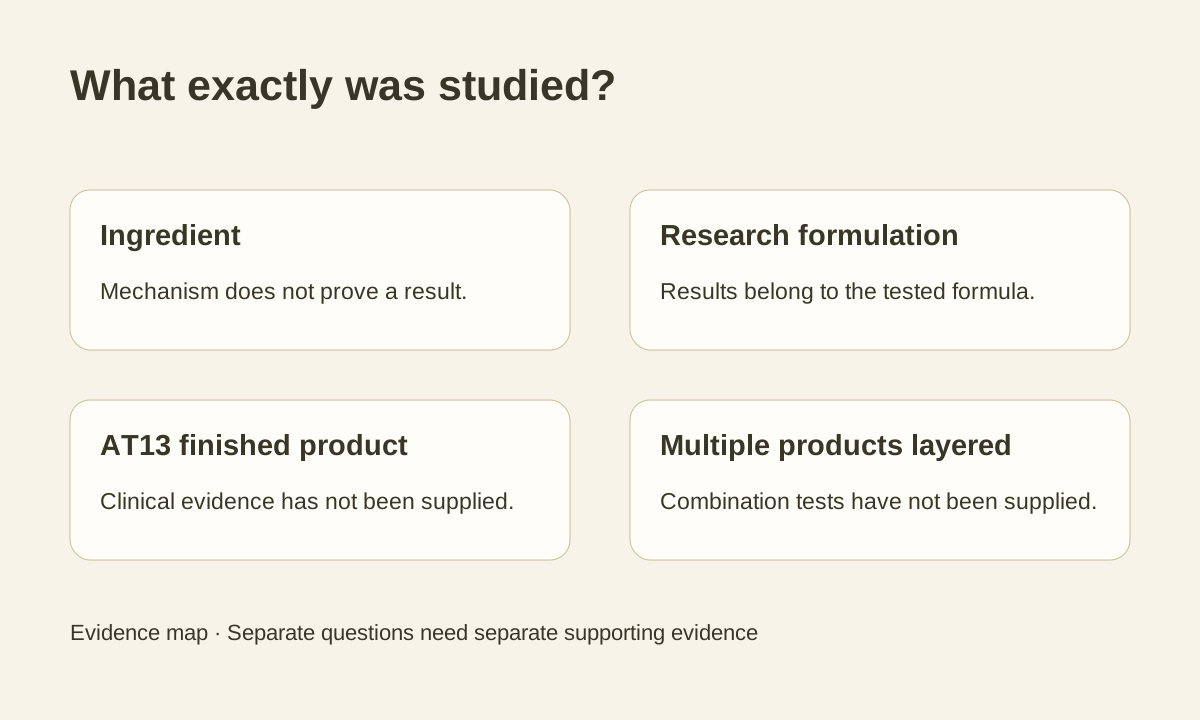
The 2014 randomized moisturizer trial, published online in 2013 studied niacinamide and tranexamic acid in one formula. It did not test AT13, NT16 or TNV3 layered together. Its result should stay attached to the tested product and study conditions.
Three Neatique labels, with overlapping ingredients
| Product | Tranexamic acid | Niacinamide/nicotinamide | Other labelled ingredient | What remains unstated |
|---|---|---|---|---|
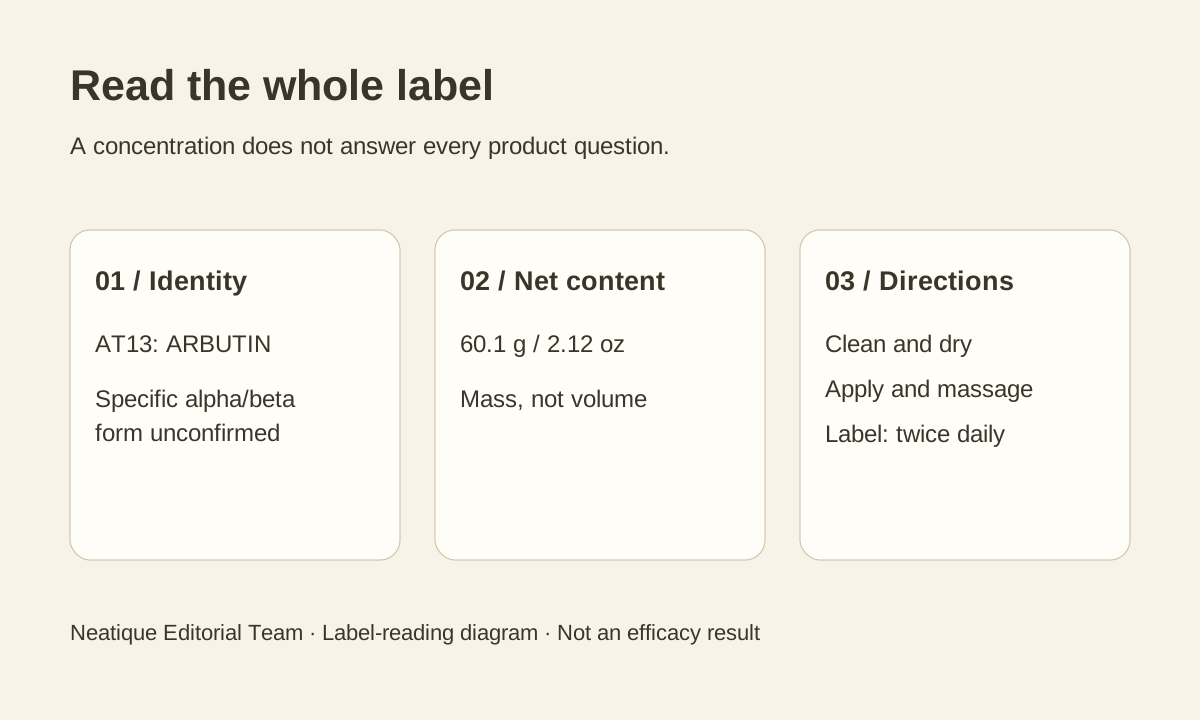
| AT13 cream | Labelled 5% | Listed; percentage not stated | Labelled 8% arbutin | Specific alpha/beta arbutin identity and combination testing |
| NT16 serum | Labelled 5% | Labelled 11% niacinamide | ARBUTIN listed; percentage not stated | Specific arbutin form and AT13 layering outcomes |
| TNV3 serum | Labelled 10% | Labelled 2% nicotinamide | Labelled 2% vitamin C; INCI lists 3-O-ETHYL ASCORBIC ACID | Finished-product stability and AT13 layering outcomes |
Nicotinamide and niacinamide are names for the same ingredient. A front-panel vitamin C claim is not enough to assume a particular vitamin C form or a concentration of another ingredient. Ingredient order should not be converted into a guessed percentage.
The complete ingredient lists also show arbutin overlap between AT13 and NT16, while AT13's niacinamide percentage is unstated. Record these supporting ingredients even when they are absent from a product's headline name. The TNV3 INCI name identifies what the manufacturer declares; it does not independently establish raw-material purity or performance after layering.
Do not add percentages across bottles
Putting a 5% and a 10% product into a routine does not establish a “15% treatment.” The applied amounts, formula bases and distribution differ. It also does not establish that a niacinamide-containing cream adds a predictable niacinamide dose to a serum.
The useful decision is whether a product fills a missing routine role and whether the complete regimen is appropriate. If a product repeats ingredients already in your routine, ask what new evidence or purpose justifies adding it. Matching themes are not a requirement to buy a set.
A check before adding vitamin C or niacinamide
- Identify the actual vitamin C ingredient and the complete INCI.
- Record what is stated, leaving unstated concentrations blank.
- Read each product's current warnings and use directions.
- Separate evidence for a single formula from evidence for the actual products layered together.
- Introduce one unfamiliar tone-focused leave-on product at a time, keeping other products stable where appropriate.
- Record comfort and stop if irritation develops.
This approach helps document the decision, but it is not an AT13 combination-safety protocol. A clinician should assess specific medical circumstances, prescription routines or persistent reactions. No AT13 finished-product combination test has been supplied for the pairings discussed here.
Choose the next guide by your task
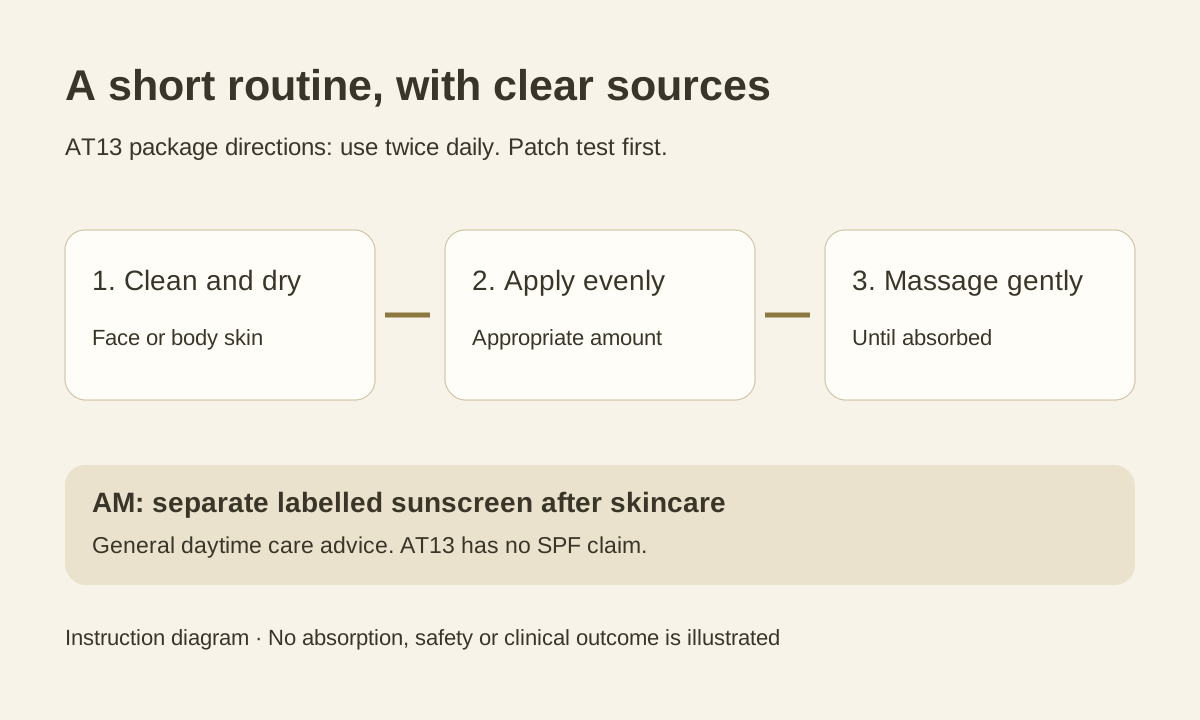
For formats, use Tranexamic Acid Serum vs Cream and the serum collection. For the evidence distinction, use Arbutin and Tranexamic Acid. AT13 is a cream with no SPF claim; adding vitamin C does not turn it into a sunscreen.
Frequently asked questions
Is nicotinamide different from niacinamide in TNV3?
They are names for the same ingredient. Copy the product's exact label wording when recording its facts.
Is AT13 niacinamide-free?
No. NIACINAMIDE appears in its INCI, although its percentage is not stated.
Does a combination trial establish AT13 plus TNV3 safety?
No. A trial of another single formula does not test those finished products used together.
Can I infer the vitamin C form from “2% vitamin C”?
Use the full current INCI or manufacturer documentation to identify the form. Do not assume it from the front panel alone.