

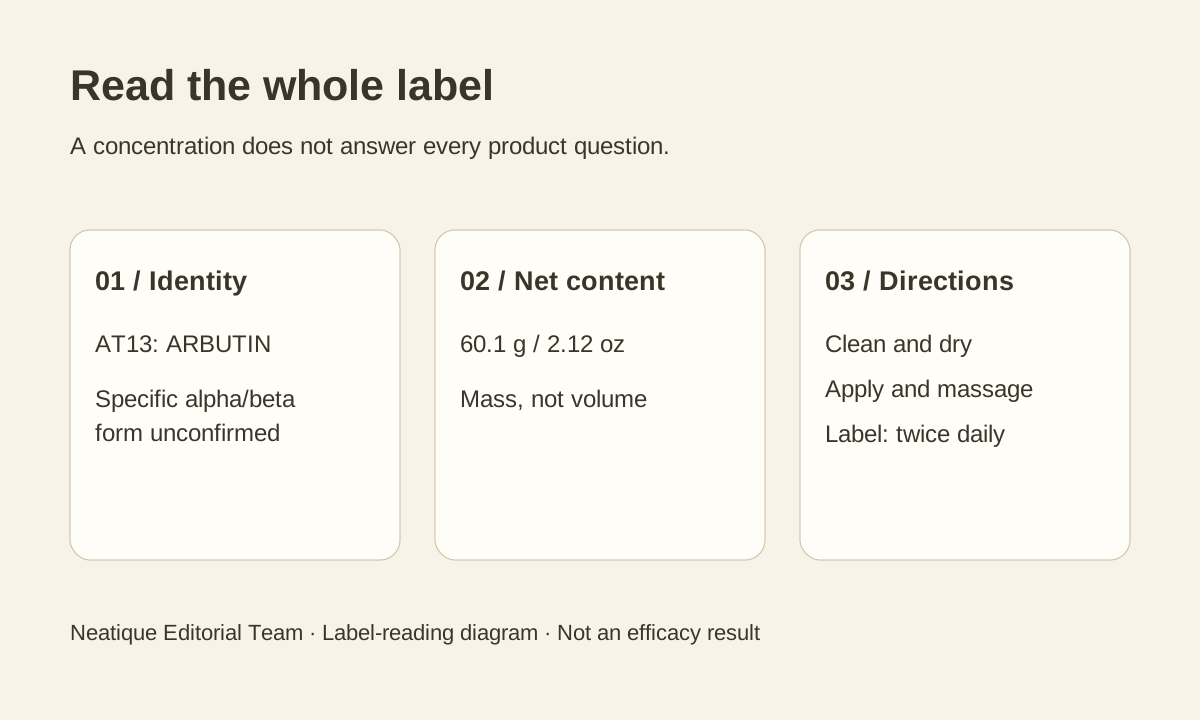
Arbutin and alpha arbutin are not labels you should interchange without checking the ingredient identity. Read the full INCI, confirm which form the manufacturer identifies, and compare percentages only within that context. Neatique AT13 prints ARBUTIN; its specific alpha/beta form is unconfirmed.
Names, forms and the label you can verify
Arbutin's alpha and beta forms differ in the configuration of their glycosidic bond. A product's front panel may use a broad marketing name, while its ingredient list supplies a more specific name. When the label or supplier documents do not resolve the form, record the uncertainty instead of borrowing an answer from a similar product.
| Label or document | What you can record | What needs another source |
|---|---|---|
| ALPHA-ARBUTIN in a verified INCI | The manufacturer labels that ingredient as alpha arbutin | Finished-product performance, stability and tolerance |
| ARBUTIN on the AT13 package | AT13 lists ARBUTIN | AT13's specific alpha/beta identity and supplier documentation |
| A front-panel percentage | The stated concentration and wording | Whether it is directly comparable with a different form or formula |
| Another brand's explanation | Facts about that brand's documented product | Identity or directions for AT13 |
An ingredient name alone cannot verify purity, impurities or the finished formula's safety. Those questions need suitable product and supplier evidence.
Why “more percent” is an incomplete comparison
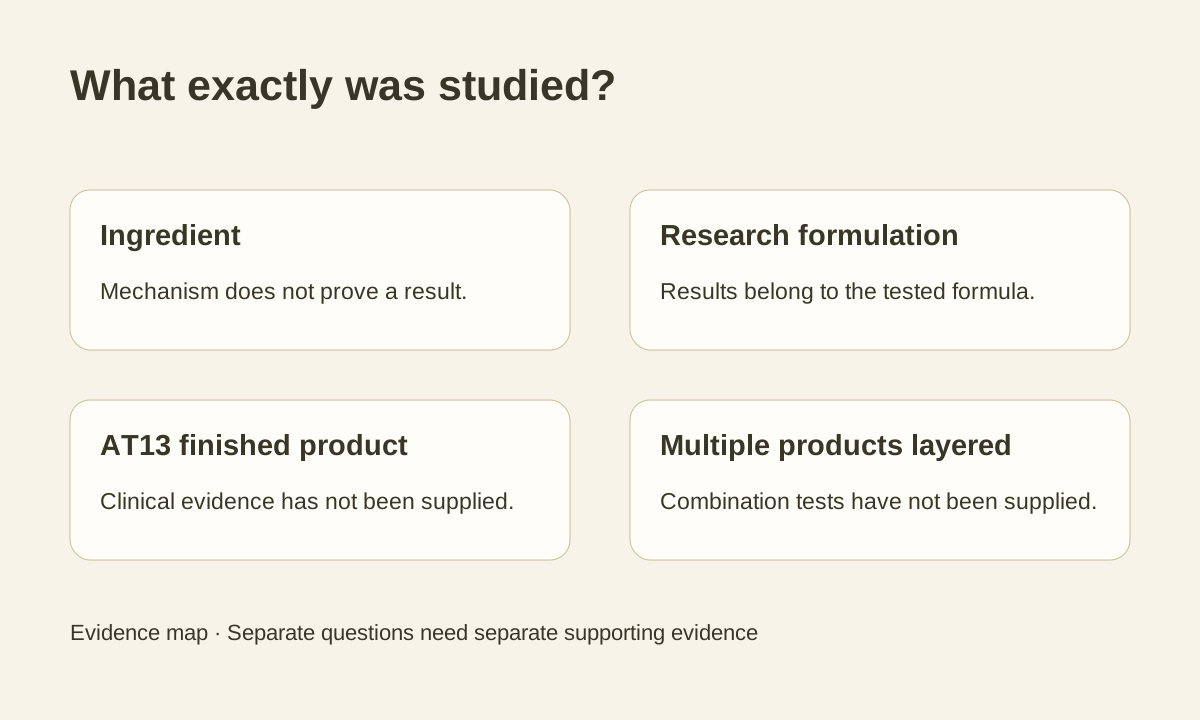
A laboratory comparison of alpha and beta arbutin and tyrosinase used enzyme systems rather than a consumer's finished skincare routine. Such work helps explain why ingredient form matters; it cannot establish a conversion such as “2% alpha equals 8% arbutin” for clinical results.
A cream and serum may also differ in their bases, delivery, other ingredients and instructions. A percentage does not reveal how much you apply, what remains stable over storage or whether a particular finished product suits your circumstances. Compare products using a complete fact sheet, not a single numerical ranking.
How to read the SCCS opinion responsibly
The European Commission's SCCS/1642/22 opinion evaluates alpha arbutin and beta arbutin separately. Its conclusions concern specified concentrations and product types, including alpha arbutin at up to 2% in face creams and 0.5% in body lotions, and beta arbutin at up to 7% in face creams, with conditions discussed in the opinion.
These values are not an AT13 safety assessment, a universal usage recommendation or a statement of US legal compliance. AT13's labelled 8% arbutin and unresolved specific form cannot be cleared by citing that opinion. Ingredient identity, impurity control, product assessment and applicable requirements need qualified review. Patch testing does not replace that work.
The AT13 fact check
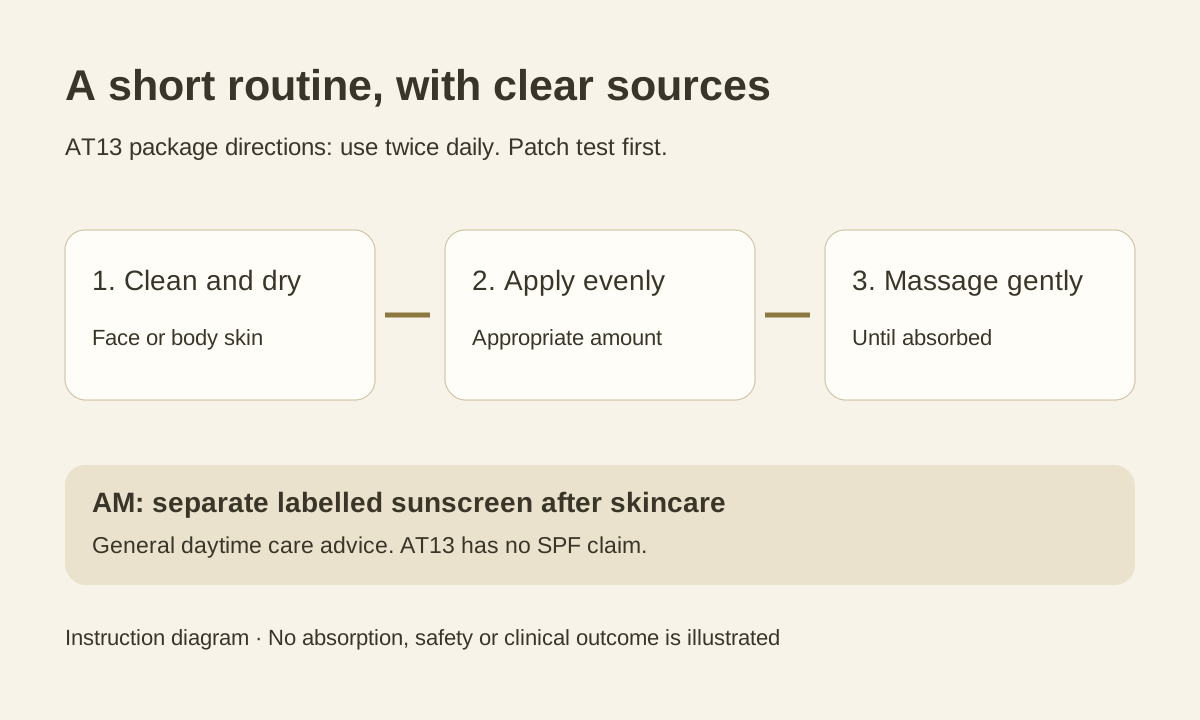
AT13 cream is labelled 8% arbutin and 5% tranexamic acid. Neatique confirms a volume of 60 mL; packaging net weight is 60.1 g / 2.12 oz. Its directions say clean and dry skin, apply evenly, massage until absorbed and use twice daily. The complete packaging INCI is published on the product page. Finished-product clinical results and specific alpha/beta supplier confirmation have not been supplied.
Read the combination evidence and Arbutin vs Tranexamic Acid for the next comparison. A product question about pregnancy, a recent procedure or ongoing irritation deserves advice from a qualified clinician rather than a conclusion based on an ingredient percentage.
Frequently asked questions
Can I call AT13 an alpha arbutin cream?
Not from the evidence currently held for this guide. The INCI reads ARBUTIN and specific form confirmation is outstanding.
Does the SCCS opinion prove AT13 is safe?
No. It addresses defined ingredients, concentrations and conditions, and does not evaluate AT13's finished formula.
Is a larger percentage always more effective?
No clinical ranking follows from the number alone. Identity, formulation, study design and relevant finished-product evidence matter.
What should I ask a brand to supply?
Ask for the current INCI, exact ingredient identity, product version, directions, warnings and the scope of any finished-product testing. An unanswered question should remain recorded as unanswered.