

PDRN stands for polydeoxyribonucleotide, a name used for mixtures of DNA-derived chains or fragments. On cosmetic labels, the related INCI name may appear as Sodium DNA. PDRN is also discussed in medical and aesthetic settings, but a topical cosmetic is not the same intervention as an injection. Route, dose, formulation and contact time determine which conclusions are reasonable.
PDRN skincare in brief
- PDRN and Sodium DNA may appear on serums, creams and rinse-off cleansers.
- The full formula matters more than the headline ingredient alone.
- A percentage only has meaning when the label clearly identifies what it measures.
- Evidence from injections cannot be treated as proof for an ordinary topical cosmetic.
- Neatique's current materials list Sodium DNA but do not state whether its source is salmon, plant, fermentation-derived or synthetic.
What PDRN and Sodium DNA mean on a label
PDRN is not one small, uniform molecule. In product marketing it can describe a DNA-derived ingredient family, while an ingredient declaration may use Sodium DNA. That difference makes the full INCI, source documentation and any stated concentration more useful than a front-label trend term by itself.
Traditional PDRN materials are often described in scientific literature as being purified from salmonid reproductive material. That general history does not prove the source of a specific cosmetic. Neatique's current cleanser, serum and cream materials identify Sodium DNA, but they do not document a salmon source. The responsible answer for these products is therefore source not stated.
People who avoid animal-derived ingredients should not assume the formulas are salmon-derived or vegan. A source claim requires supplier or manufacturing documentation that matches the ingredient used in the finished product.
How to read a PDRN percentage
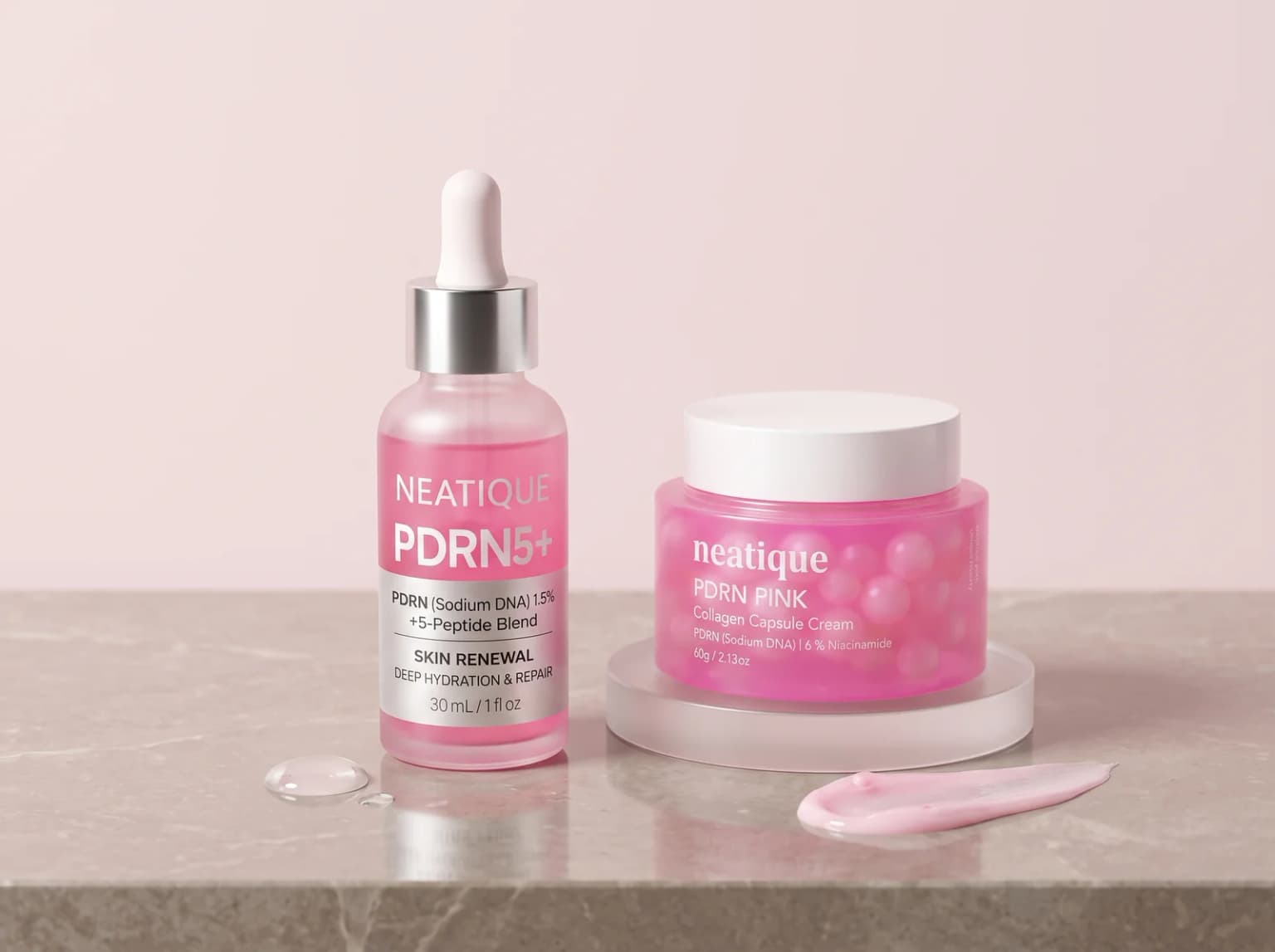
A percentage should be tied to a clearly named material. The Neatique PDRN5+ Serum lists PDRN (Sodium DNA) at 1.5%. The PDRN Pink Collagen Capsule Cream lists Sodium DNA in its INCI and separately states 6% niacinamide; it does not state a Sodium DNA percentage.
The PDRN Pink 99% + Niacinamide Whip Cleanser uses 99% as part of the product name. The package does not say that 99% of the finished cleanser is PDRN, so the number should not be presented as a finished-product concentration. Its complete ingredient list belongs on the product page, where order, spelling and cautions can be checked in context.
PPM and percentage are concentration units, not stand-alone quality scores. A larger-looking number does not explain the source, purity, molecular characteristics, supporting formula or finished-product performance. Compare numbers only when the labels define the same material and unit.
What topical PDRN evidence can and cannot show
Published PDRN research includes laboratory work, animal research, wound-related applications, injections and a smaller body of topical studies. One recent topical study evaluated a specific 0.1% PDRN preparation around the eye. That result is evidence about that preparation and study design, not automatic proof for every PDRN cleanser, serum or cream.
When reading a study, ask whether the route was topical or injected, whether people or laboratory models were studied, whether the tested material matches the product, and whether the outcome matches the claim. A finished cosmetic should not borrow medical repair, regeneration or treatment claims from a different route. The FDA explains the legal boundary between cosmetics and drugs.
For ordinary skincare, the most defensible expectations concern the complete formula's texture, hydration, comfort and visible surface appearance. Humectants, emollients, niacinamide, peptides and the product base may contribute substantially to those effects.
PDRN cleanser, serum and cream are different formats
Cleanser
A cleanser is mixed with water and rinsed away. Its useful job is to remove everyday buildup comfortably. Contact time is short, so it should not be described as though it replaces a leave-on treatment.
Serum
A serum is the lighter leave-on layer. The Neatique PDRN5+ Serum is a 30 mL formula whose package states 1.5% Sodium DNA and a five-peptide blend. Apply it after cleansing and before moisturizer.
Cream
A cream is the moisturizer step. The Neatique PDRN Pink Collagen Capsule Cream is a 60 g formula with 6% niacinamide, Sodium DNA, hydrolyzed collagen and listed peptides. It can be used after serum or on its own when a separate serum is unnecessary.
The PDRN skincare collection compares all three formats by routine role. Choosing one useful step is usually more practical than assuming a matching set is required.
A simple PDRN routine
- Cleanse briefly and rinse completely.
- Apply a thin serum layer if your routine needs it.
- Follow with cream where more moisture feels useful.
- Finish the morning routine with broad-spectrum sunscreen according to its label.
If serum and cream form visible rolls, use less product, let each layer settle and reduce rubbing. The PDRN serum and cream layering guide provides a step-by-step method. If cleansing leaves skin uncomfortable, use the gentle PDRN cleanser method.
Safety and source questions
Follow each product's current directions and warnings. Patch test unfamiliar leave-on formulas, avoid broken or irritated skin unless a label specifically permits use, and stop if persistent burning, swelling, hives or rash develops. People who are pregnant, nursing, using prescription skincare or managing a diagnosed condition should seek individualized professional guidance.
Frequently asked questions
Is Neatique PDRN salmon-derived?
The current materials list Sodium DNA but do not state its source. Neatique therefore does not claim that these products are salmon-derived or vegan.
Is PDRN skincare the same as an injection?
No. A topical cosmetic stays on or is rinsed from the skin surface, while an injection bypasses the skin barrier and is a medical or aesthetic procedure. Evidence for one route does not automatically establish results for the other.
Can PDRN be used every day?
Follow the directions for the specific formula. The Neatique products are positioned for daily use, but frequency should be reduced or stopped if discomfort develops.
Is more PDRN always better?
No. Concentration alone does not establish source, quality, delivery or finished-formula performance. Compare clearly defined label facts and the role of the complete product.